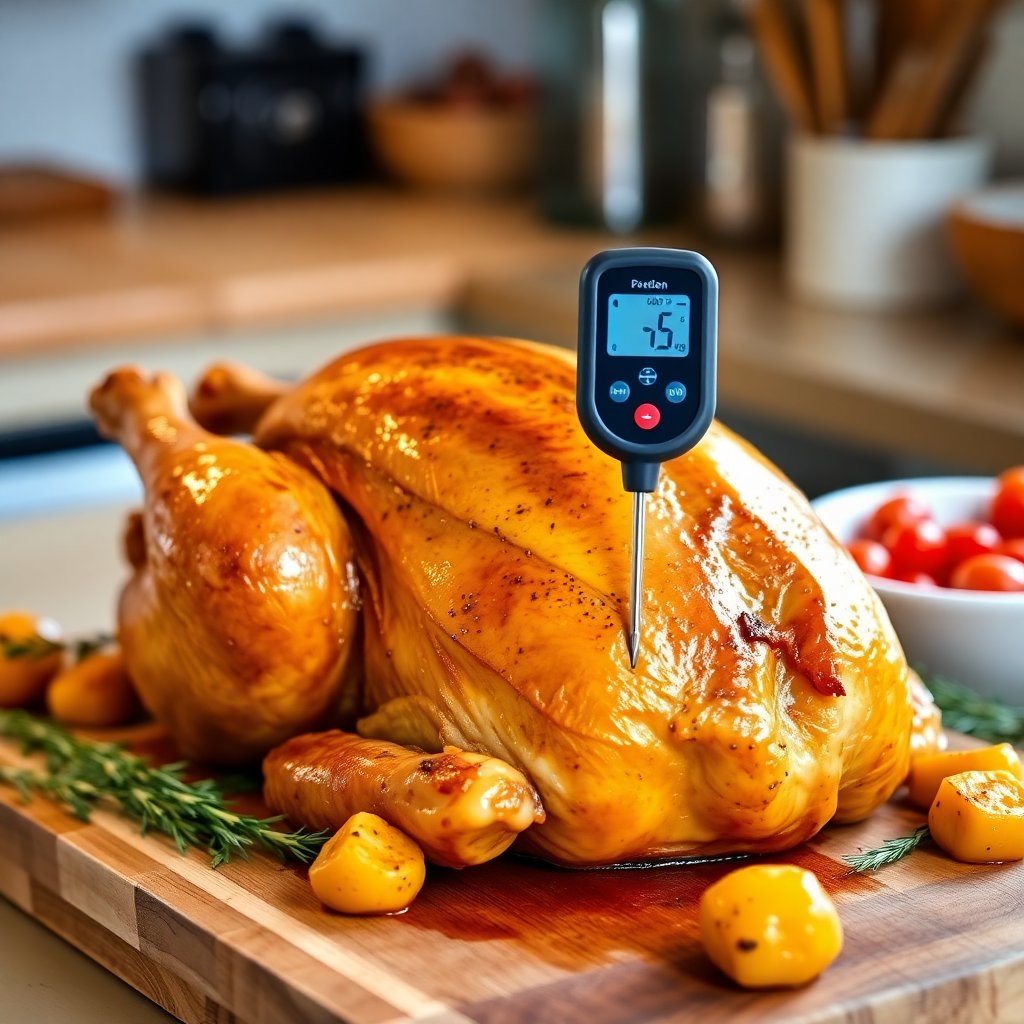
Thanksgiving is ten days away, and the single most useful thing you can buy before then costs less than the turkey. A reliable meat thermometer takes the guesswork out of the biggest roast most people cook all year. It tells you when the bird is safe, when to pull it before it dries out, and whether the stuffing in the middle is actually done.
Pop-up timers and "15 minutes per pound" charts get you in the neighborhood. A thermometer gets you to the actual number. This guide covers the three main types worth buying in 2026, how to choose between them, the temperatures to aim for, and the mistakes that throw off a reading.
Disclosure: 100 Products earns a commission on qualifying Amazon purchases made through links on this page, at no extra cost to you. We only include product types we would put in our own kitchens.
The Short Version
- Best for most kitchens: A fast, waterproof instant-read thermometer with a folding probe. You will use it every week, not just on Thanksgiving.
- Best for big roasts and set-and-forget cooking: A wired leave-in probe with an alarm. The cable runs out of the oven door to a base unit on the counter.
- Best for smokers, grills and hosts who want to walk away: A wireless smart probe that reports to your phone.
- Best combo: A leave-in probe for monitoring plus an instant-read for spot checks. That pairing covers nearly every situation.
Type 1: Instant-Read Thermometers
What it is: A handheld thermometer with a thin probe you insert, read and remove. Better models give a stable reading in roughly two to four seconds.
Why it is our top pick: Speed matters more than people realize. Every time you open the oven to check a turkey, it loses heat. A fast thermometer means you can check several spots (breast, thigh, stuffing) in under a minute and close the door.
What to look for:
- Reading speed of about 3 seconds or less. Slow thermometers tempt you to pull out before the number settles.
- Thin probe tip. A narrow tip reads faster and leaves smaller holes for juices to escape.
- Waterproofing (IP65 or higher). You can rinse it under the tap without worrying.
- Backlit, auto-rotating display. Handy when you are reaching into a dim oven at an awkward angle.
- Calibration option. Lets you check it against ice water and correct small drift.
Well-known names: ThermoWorks' Thermapen line is the reference point many cooks compare against and is mainly sold direct, while brands like ThermoPro, Lavatools and Kizen offer capable folding models on Amazon at lower prices. Specs and prices change often, so compare current listings before buying.
→ Shop fast instant-read meat thermometers on Amazon
Type 2: Wired Leave-In Probe Thermometers
What it is: A metal probe stays in the meat for the whole cook, connected by a heat-resistant braided cable to a base unit outside the oven. You set a target, and an alarm goes off when the meat reaches it.
Why it is great for turkey: You never open the oven to check. You just watch the number climb. Many units also show the rate of rise, which helps you time side dishes.
What to look for:
- Dual probes, so you can monitor breast and thigh at once, or meat plus oven air temperature.
- Programmable target alarms, ideally with presets you can override.
- A magnetic back or stand for the base unit so it sticks to the oven or stands on the counter.
- Cable rated for high oven heat. Check the listed maximum and keep the cable away from direct flame or broiler elements.
The tradeoff: The cable can be fiddly, and probes eventually fail if they get soaked or kinked. Hand wash only and avoid submerging the cable joint.
→ Shop dual-probe leave-in oven thermometers on Amazon
Type 3: Wireless Smart Probes
What it is: A self-contained probe with no cable. The sensor sits in the meat and the handle end sticks out, transmitting by Bluetooth (sometimes relayed through a booster or Wi-Fi bridge) to an app. Many models read both the internal meat temperature and the ambient temperature around it.
Why people love them: You can mingle with guests, check the turkey from the couch, and get a notification when it is time to pull. Some apps also estimate how much time is left and account for carryover cooking.
Popular options: MEATER, ThermoMaven, ThermoPro and Combustion are among the brands people compare. Each takes a slightly different approach to range, number of sensors and app features.
What to look for:
- Real-world range. Advertised ranges assume open air. A closed oven or a thick-walled smoker cuts range significantly, so a repeater or base station helps.
- Battery life and charging case. You want enough charge for a long smoke.
- Probe thickness. Thicker probes can be awkward in smaller cuts and leave larger holes.
- App quality. Read recent reviews; a clunky app ruins an otherwise good probe.
The tradeoff: More money per probe, a learning curve, and you need to insert it deep enough that the sensor sits in the meat while the handle stays out of direct high heat. For a single turkey a year, a wired probe does the same job for less.
→ Shop wireless smart meat thermometers on Amazon
Which Type Should You Buy?
| Your situation | Best pick | | --- | --- | | Cook a few nights a week, want one tool | Instant-read | | Roast a turkey once or twice a year | Wired leave-in, plus an instant-read if budget allows | | Smoke brisket, pork shoulder or turkey outdoors | Wireless smart probe or multi-probe wired unit | | Hosting and want to stay out of the kitchen | Wireless smart probe | | Buying a gift | A quality instant-read is the safest bet |
If you only buy one, buy a fast instant-read. It handles turkey, steak, chicken thighs, bread, candy-adjacent tasks and reheated leftovers. A leave-in probe is a nice upgrade for long roasts, but it is the second thermometer, not the first.
Temperatures to Know for Thanksgiving
The USDA recommends cooking all poultry, including whole turkey and any stuffing, to a safe minimum internal temperature of 165°F, measured with a food thermometer. You can confirm the full list of targets on the federal safe minimum internal temperatures chart.
A few practical notes:
- Carryover cooking. A large turkey continues to rise in temperature after it comes out of the oven, often by several degrees as it rests. Many cooks pull the bird a little before 165°F in the breast and let carryover finish the job, then confirm with a thermometer after resting. If you are not comfortable with that approach, simply cook to 165°F.
- Thighs like it hotter. Dark meat is safe at 165°F but many people find it more tender at 175 to 180°F, because connective tissue breaks down further.
- Stuffing counts. If you cook stuffing inside the bird, the center of the stuffing also needs to reach 165°F. That is one reason many cooks bake it separately.
- Ham, beef and pork have different targets. Check the chart for whatever else is on your menu.
Where to Put the Probe
Most bad readings come from probe placement, not the thermometer.
- Breast: Insert horizontally from the neck end into the thickest part of the breast, aiming for the center. Avoid touching bone, which reads hotter.
- Thigh: Insert into the thickest part of the inner thigh, near but not touching the joint.
- Check more than one spot. Ovens have hot and cool zones. Take the lowest reading as your true number.
- Go deep enough. Many probes have a sensing zone near the tip. With a leave-in or wireless probe, follow the manufacturer's minimum insertion line.
Calibrating and Caring for Your Thermometer
Ice-water test. Fill a glass with crushed ice, add cold water, stir, and wait a minute. Insert the probe without touching the glass. It should read 32°F. If it is off by more than a degree or two, use the calibration function or factor in the difference.
Clean it right. Wipe the probe with hot soapy water or an alcohol wipe between uses, especially after checking raw poultry. Do not put any thermometer in the dishwasher unless the manufacturer explicitly says it is safe.
Store it safely. Folding probes protect themselves. Straight probes should go back in their sheath so the tip does not get bent.
Replace batteries before the holiday. A dying battery can cause slow or erratic readings. Swap it this week rather than on Thanksgiving morning.
Other Gear That Pairs Well
A thermometer does its best work alongside a few other tools. A heavy roasting pan or large cast iron skillet helps the bird cook evenly; our guide to the best cast iron pans covers sizes that fit smaller birds and turkey breasts. For braised sides and gravy, an enameled Dutch oven is hard to beat. And if you are rounding out the kitchen drawer, our list of Amazon kitchen gadgets worth buying has more inexpensive tools that earn their spot.
→ Shop roasting pans with racks on Amazon
Common Mistakes to Avoid
- Trusting the pop-up timer. Many are set to trigger at a temperature that leaves the breast overcooked, and they are not always accurate. Use them as a backup at most.
- Reading too soon. Wait for the number to stop climbing, even with a fast thermometer.
- Probing too close to the surface. The outside of a roast is always hotter than the center.
- Leaving an instant-read in the oven. Most handheld models are not oven-safe and the display can be damaged by heat.
- Ignoring the resting period. Give the turkey 20 to 40 minutes under loose foil. Juices redistribute and carryover finishes the cook.
Is a Meat Thermometer a Good Gift?
Yes, and a timely one. It is practical, it fits in a stocking, and it is the kind of tool people put off buying for themselves. A quality instant-read is the safest choice for most recipients. For someone who already owns one, or who spends weekends at the smoker, a wireless probe is a more exciting upgrade. Black Friday is November 27 this year, and thermometers are a category that often goes on sale, so it can pay to compare prices around then if you are buying for someone else. For your own Thanksgiving turkey, though, buy now so you can practice on a chicken first.
The Bottom Line
A meat thermometer is the easiest way to make Thanksgiving dinner less stressful. Start with a fast, waterproof instant-read, add a leave-in or wireless probe if you roast or smoke often, and remember the key numbers: 165°F for turkey and stuffing, with thighs often better a little higher. Check it in ice water before the big day, swap the battery, and you will carve with confidence instead of crossing your fingers.
As an Amazon Associate we earn from qualifying purchases. This article contains affiliate links; if you buy through them we may earn a small commission at no additional cost to you.