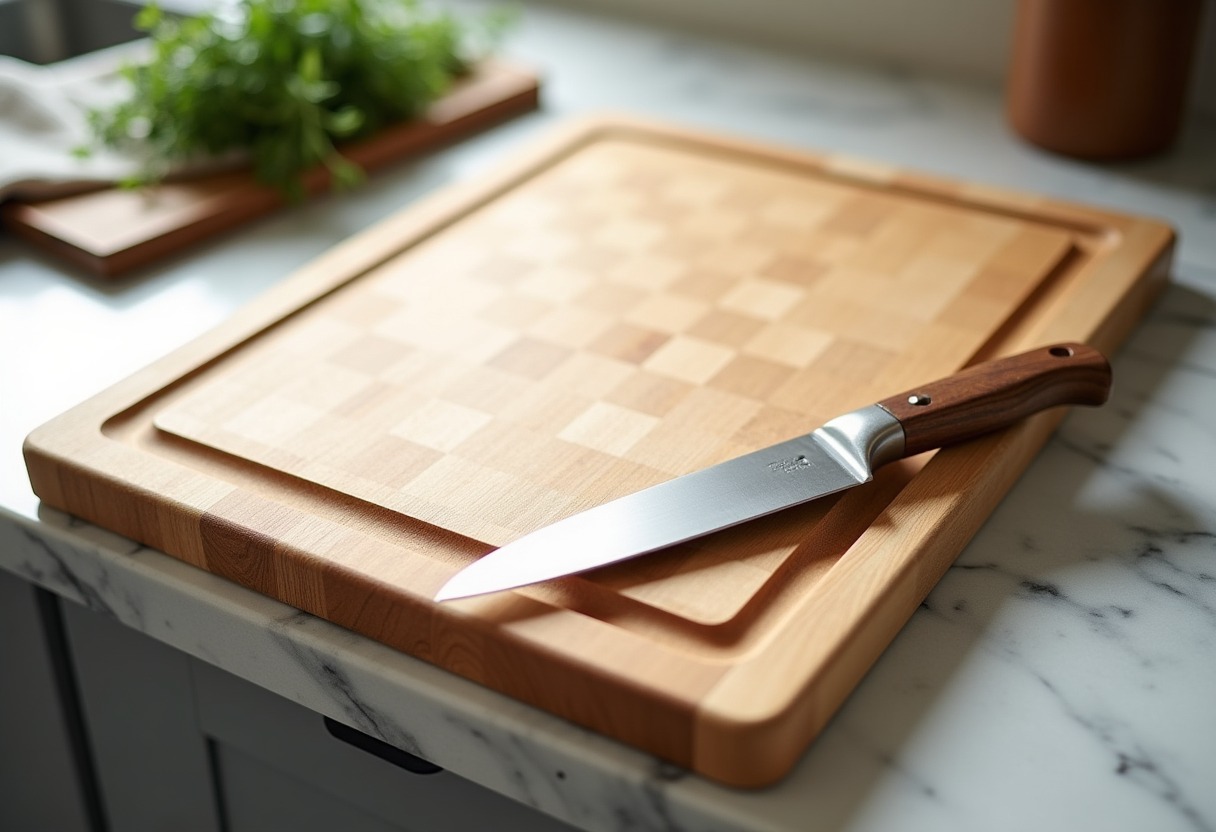
A good cutting board takes hundreds of knife strikes weekly and stays flat, doesn't warp, and keeps your knives sharp for years. Most home cooks replace theirs every 18 months because they bought the wrong material or skipped basic maintenance that takes 90 seconds per week.
Why Material Choice Matters More Than Price
The cutting board industry sells three main material categories, and each trades specific benefits for specific maintenance requirements. Wood cutting boards close their own knife scars through wood fiber compression, plastic boards resist moisture but show every cut permanently, and composite materials split the difference with moderate self-healing and easier cleaning.
Your knife edges hit the board surface thousands of times. Hardness matters. The Janka hardness scale measures wood density—walnut scores 1,010, maple hits 1,450, and bamboo reaches 1,380. Softer woods like walnut close knife marks better but dent from dropped cans. Harder woods resist denting but transmit more impact to your knife edge. Plastic boards made from high-density polyethylene (HDPE) measure around 60-80 on the Shore D hardness scale, which translates to gentler impact on blades than ceramic or glass but more dulling than quality hardwood.
The USDA found that both wood and plastic boards can be sanitary if properly maintained, contradicting older assumptions that only plastic could be safely cleaned. Wood contains natural antimicrobial compounds—specifically tannins and other phenolic compounds—that slow bacterial growth, though this doesn't replace proper washing.
Wood Cutting Boards: Edge Grain vs End Grain
Wood boards come in two construction types that dramatically affect durability. Edge grain boards show the wood plank sides—long, straight grain lines running the board length. → Shop wood cutting boards on Amazon. End grain boards show the cross-sections of wood pieces arranged in a checkerboard pattern, with grain running perpendicular to the cutting surface.
End grain construction costs 40-60% more but lasts three times longer. When you cut on end grain, knife edges slip between wood fibers instead of severing them. The board self-heals as fibers push back together. Edge grain boards take cuts across the grain, leaving permanent score marks that deepen with use. After two years of daily chopping, a quality end grain board shows minimal scarring while edge grain surfaces look heavily scored.
Thickness matters for stability. Boards under 1.25 inches warp within 18 months under humidity changes. Professional kitchens use 1.75 to 2-inch thick boards that stay flat for 5-7 years. The extra weight—usually 10-15 pounds for a 12x18-inch board—prevents sliding during hard chopping without grip feet that trap moisture and bacteria.
Walnut, maple, cherry, and teak dominate quality boards. Walnut's 1,010 Janka rating makes it the softest common choice, ideal if you sharpen your knives from the Best Kitchen Knife Sets frequently. Maple's 1,450 rating resists denting from heavy cleavers and dropped items. Teak contains natural oils that repel moisture—it needs monthly oiling instead of weekly—but costs double other hardwoods.
Bamboo boards occupy a middle tier. Technically a grass, bamboo grows rapidly and costs less, but its 1,380 Janka rating and tendency to splinter along fiber edges make it harder on knife edges than maple or walnut. Quality bamboo boards work fine for vegetables and boneless proteins, but heavy cleaver work or bone contact chips the surface.
→ Shop end grain cutting boards on Amazon
Plastic and Composite Cutting Boards: When Convenience Wins
Restaurant health codes require color-coded plastic boards—red for raw meat, green for vegetables, yellow for poultry—to prevent cross-contamination. Home cooks benefit from this system when preparing multiple proteins. High-density polyethylene (HDPE) plastic resists warping, survives dishwasher cycles, and costs one-third what wood boards run.
The tradeoff: plastic boards show every knife mark permanently. Deep grooves trap food particles and bacteria, requiring replacement every 12-18 months with daily use. NSF International—the organization that creates public health standards—recommends replacing plastic boards when knife marks create grooves you can feel with your fingernail.
Composite boards blend wood fiber with resin, creating a surface that resists moisture like plastic but feels slightly softer under the knife. Epicurean and similar brands make composite boards from compressed wood pulp and resin that survive commercial dishwashers while maintaining moderate knife-friendliness. These boards don't self-heal like end grain wood but resist the deep scarring that ruins plastic boards within a year.
→ Shop plastic cutting boards on Amazon
Rubber cutting boards, made from soft rubber compounds, absorb knife impact well but grip the blade on the downstroke, creating drag that fatigues your cutting hand. Professional prep cooks avoid them except for specific tasks like sushi work where the grip prevents proteins from sliding.
Material Comparison: Real-World Performance
| Material | Knife Friendliness | Maintenance Time/Week | Typical Lifespan | Dishwasher Safe | Price Range | |----------|-------------------|----------------------|------------------|----------------|-------------| | End Grain Wood | Excellent (self-healing) | 5-10 min (oiling monthly) | 5-10 years | No | $80-$300 | | Edge Grain Wood | Good | 5-10 min (oiling monthly) | 2-4 years | No | $30-$100 | | HDPE Plastic | Fair (shows all cuts) | 2 min | 12-18 months | Yes | $15-$40 | | Composite | Good | 2 min | 3-5 years | Yes | $25-$60 | | Bamboo | Fair to Good | 5-10 min (oiling monthly) | 2-3 years | No | $20-$50 |
Product Recommendations for Different Cooking Styles
For Daily Home Cooking: Large Edge Grain Maple Board
A 15x20-inch edge grain maple board handles everything from weeknight dinners to weekend meal prep. The 1.5-inch thickness prevents warping, and maple's closed grain structure resists moisture absorption better than oak or ash. Monthly oiling with food-grade mineral oil keeps the surface smooth. → Shop bamboo cutting boards on Amazon
For Serious Home Cooks: End Grain Walnut or Maple
End grain boards from reputable makers—Boos, Teakhaus, Brooklyn Butcher Blocks—use edge-glued construction that prevents separation. A 12x18-inch end grain board weighs 12-15 pounds, eliminating the need for grip feet. Walnut's dark color hides stains from berries and beets better than maple's light grain. If you work through recipes from the Best Amazon Kitchen Gadgets 2026 regularly, the self-healing surface justifies the cost.
For Raw Protein Handling: NSF-Certified Plastic Board Set
Color-coded HDPE boards prevent the cross-contamination that wood boards risk despite proper cleaning. Sets include four boards (typically 12x18 inches) with textured surfaces that grip under running water. Replace these annually or when grooves trap visible debris. Store them vertically in a rack that allows air circulation—stacking wet boards grows mold.
For Small Kitchens: Composite Epicurean Board
Composite boards from Epicurean measure 0.25 inches thick, allowing drawer storage without the counter footprint of thick wood boards. An 11x14-inch size handles most prep work and goes straight in the dishwasher. The paper-composite construction resists odor absorption from garlic and onions better than plastic. These work perfectly alongside items from our Best Non Toxic Cookware Sets guide.
→ Shop composite cutting boards on Amazon
For Multi-Purpose Use: Reversible Teak Board
Teak's natural oil content makes it the lowest-maintenance wood option. A reversible teak board gives you two surfaces—use one side for proteins, flip for vegetables and fruits. The 1.5-inch thickness and 18x24-inch size accommodates carving large roasts or breaking down whole chickens. Teak boards need oiling every 4-6 weeks instead of weekly, saving maintenance time.
Maintenance Reality: What Actually Works
Wood cutting boards need mineral oil—never vegetable oil, which turns rancid—applied monthly for new boards, then every 6-8 weeks after the first year. Pour a tablespoon on the surface, spread with a paper towel, let it sit 20 minutes, then wipe excess. Boards that feel dry or show a whitish appearance need immediate oiling. A combination of mineral oil and beeswax creates a harder finish that sheds water better but requires reapplication every three months.
Daily cleaning matters more than deep cleaning. Wash wood boards with hot soapy water immediately after use, then stand them on edge to air dry completely. Never soak wood boards or leave them in standing water—the moisture differential between wet and dry sides causes warping. For protein residue, scrub with coarse salt and half a lemon, then rinse and dry thoroughly.
Deep stains and odors respond to a paste of baking soda and water, spread on the surface and left for five minutes before scrubbing. Diluted hydrogen peroxide (one part peroxide to four parts water) removes stubborn stains but strip some wood color with repeated use—acceptable for maple, problematic for darker woods like walnut or cherry.
Plastic boards go in the dishwasher, but the high heat gradually warps cheaper boards. Top-rack placement reduces warping. Every two weeks, sanitize plastic boards by spraying with diluted bleach solution (one tablespoon bleach per gallon of water), letting it sit for two minutes, then rinsing thoroughly. This kills bacteria in deep knife grooves.
Composite boards combine the best of both: dishwasher-safe like plastic but less prone to warping. They handle the same cleaning protocols as plastic without the deep scarring problem.
Advanced Considerations Most Reviews Skip
Board feet matter for stability. Your board should provide 50-75% more surface area than your largest cutting task. Breaking down a whole chicken requires roughly 12x15 inches of workspace. Using a board that's barely large enough means meat or vegetables slide off during cutting, creating mess and safety issues. A 15x20-inch board handles almost any home cooking task except breaking down large fish or carving turkey.
Juice grooves—the channels cut around board perimeters—trap liquid from cutting tomatoes or carving meat. They're essential for boards dedicated to proteins but create cleaning headaches on everyday vegetable boards where the grooves trap onion bits and herbs. Consider whether your cutting style needs containment or easier cleaning.
Reversibility adds value only if both sides get equal use. Most home cooks develop a preferred surface and rarely flip their boards. Single-sided boards often come with rubber feet that actually improve stability—better than reversibility you won't use.
Weight distribution affects how boards sit on counters. Center-heavy boards stay flat. Perimeter-heavy boards (common in bamboo construction with thick edge gluing) rock slightly on uneven counters, creating an unstable cutting surface. Test boards by pressing all four corners—any movement indicates poor weight distribution or warped construction.
Storage impacts lifespan as much as maintenance. Boards stored flat in damp cabinets grow mold on their bottom surfaces. Vertical storage in racks or on edge against backsplashes allows air circulation around all surfaces. Never store boards in direct sunlight—UV exposure dries wood faster than seasonal humidity changes can rehydrate it, causing cracks.
FAQ
How often should I replace my cutting board?
Wood boards last 5-10 years with proper oiling and cleaning, while plastic boards need replacement every 12-18 months when knife grooves become deep enough to trap debris. Replace any board immediately if it develops cracks, severe warping, or permanent stains that won't clean, as these indicate compromised hygiene or structural failure.
Can I use the same cutting board for meat and vegetables?
Wood boards can handle both if you wash them with hot soapy water immediately after raw protein contact and let them dry completely before reuse. For higher safety margins, use dedicated plastic boards for raw proteins—they're dishwasher-safe and easier to sanitize in the 160°F+ temperatures that kill bacteria.
Why do wood cutting boards crack and how can I prevent it?
Cracks form when one side of the board absorbs or loses moisture faster than the other, creating uneven expansion. Prevent cracking by oiling both sides equally, never leaving boards in standing water, and storing them in moderate humidity (40-60%) away from heat vents or direct sunlight.
Are bamboo cutting boards really more eco-friendly?
Bamboo grows faster than hardwood—reaching harvest size in 3-5 years versus 30-50 years for maple—making it a renewable resource. However, most bamboo boards use adhesives to bind grass strips together, and these glues sometimes contain formaldehyde or other compounds that offset the environmental benefits. Look for boards certified by the Forest Stewardship Council (FSC) for verified sustainable practices.
What's the best way to remove deep stains and odors from cutting boards?
For wood boards, scrub stained areas with coarse salt and half a lemon, letting the acidic juice sit for five minutes before rinsing. For persistent odors, make a paste of baking soda and water, spread it on the surface, leave for 10 minutes, then scrub and rinse thoroughly—this works on both wood and plastic without damaging the surface.
The Right Board Lasts Years, Not Months
Your cutting board handles more kitchen work than any other tool except your chef's knife—choose based on how you actually cook, not aspirational kitchen aesthetics. An end grain wood board that gets monthly oiling beats a cheaper edge grain board replaced every two years, and a $20 plastic board that goes through the dishwasher works better than neglected wood that warps from moisture exposure.
Some links on this page are affiliate links. We may earn a small commission if you purchase through them, at no extra cost to you.
As an Amazon Associate we earn from qualifying purchases. This article contains affiliate links; if you buy through them we may earn a small commission at no additional cost to you.