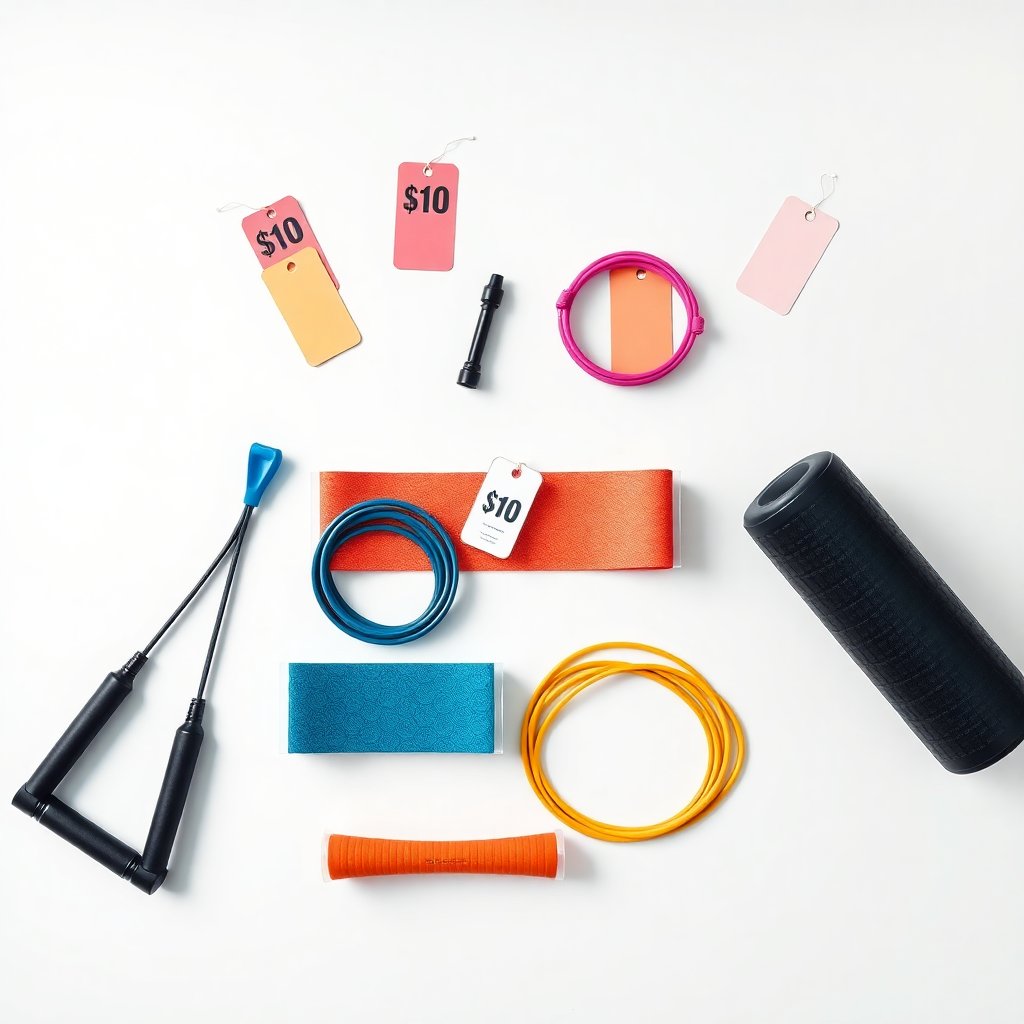
You don't need an expensive gym membership or thousands in equipment to get fit. After years of training at home, I've identified the most effective fitness gear you can buy for under $100—equipment that delivers real results without wasting money on gimmicks.
Resistance Bands: The Most Versatile Tool
Resistance bands punch far above their weight class, offering incredible exercise variety in a compact, affordable package.
Why Resistance Bands Work
I use resistance bands for everything from assisted pull-ups to shoulder rotations to leg work. They provide progressive resistance throughout the movement range—unlike free weights where certain portions feel easier.
A quality resistance band set costs $20-40 and replaces hundreds of dollars in dumbbells and cable machines. They're also perfect for travelers or anyone with limited space.
What to Look For
Buy a set with multiple resistance levels rather than a single band. I prefer fabric loop bands over latex tubes with handles—they're more durable and won't snap back if they break.
Look for bands labeled with resistance levels (light, medium, heavy, extra heavy) or weight equivalents. The variety lets you progress on exercises and use different bands for different muscle groups.
Browse resistance band sets on Amazon
Jump Rope: Cardio That Goes Anywhere
The humble jump rope remains one of the most effective cardio tools ever created, and a good one costs less than $20.
The Jump Rope Advantage
Ten minutes of jump rope provides a cardiovascular workout comparable to 30 minutes of jogging, with the added benefits of improved coordination, footwork, and bone density.
I jump rope for warm-ups before strength training and for quick cardio sessions when I don't have time for a full workout. The calorie burn is intense, and you can do it in your garage or backyard.
Choosing the Right Rope
Adjustable-length ropes accommodate different heights and jumping styles. I prefer ropes with weighted handles—they add slight resistance and help maintain rhythm.
Beginners should start with a beaded rope rather than a speed rope. Beaded ropes are slower and easier to control while you're learning proper form. Once comfortable, graduate to a speed rope for faster, more intense workouts.
Foam Roller: Recovery Investment
Quality recovery is as important as the workout itself, and a foam roller is the most cost-effective recovery tool available.
How Foam Rolling Helps
Rolling out tight muscles before and after workouts reduces soreness, improves flexibility, and helps prevent injury. I foam roll for 10 minutes before every training session to activate muscles and identify tight spots.
The difference in how I feel day-to-day since incorporating regular foam rolling has been dramatic. Less chronic tightness, fewer nagging aches, and better mobility during exercises.
Foam Roller Selection
High-density rollers last longer than soft foam ones. I learned this the hard way when my first cheap roller lost its shape after three months.
A textured roller provides deeper tissue work, though it can be uncomfortable at first. Start with a smooth roller if you're new to foam rolling, then progress to textured versions as your tolerance increases.
Adjustable Dumbbells: Strength Training Staple
If your budget allows a slightly bigger investment, adjustable dumbbells offer incredible versatility while saving space and money compared to buying multiple fixed-weight sets.
Value Proposition
A pair of adjustable dumbbells replacing several sets of fixed weights pays for itself quickly. I use mine for everything from curls to rows to shoulder presses to weighted lunges.
The adjustment mechanism lets you progress over time and use different weights for different exercises without cluttering your space with a rack of dumbbells.
What to Choose
Dial-adjustment systems (like PowerBlock or SelectTech) are fast to change but cost more. Spin-lock adjustable dumbbells require manually loading plates but typically fall under $100 for a basic set.
For most home users, spin-lock dumbbells provide the best budget option. They're not as quick to adjust, but if you're not rapidly changing weights mid-circuit, the savings are worth it.
Suspension Trainer: Bodyweight Multiplier
A suspension trainer (like TRX or similar) turns your bodyweight into a complete gym. They anchor to a door, tree, or pull-up bar and enable hundreds of exercises.
Why Suspension Training Works
Suspension trainers engage stabilizer muscles more than traditional exercises because you're working on an unstable surface. A suspension push-up is significantly harder than a regular push-up.
I use mine for rows, chest presses, pike push-ups, hamstring curls, and core work. The adjustable difficulty (changing body angle) makes exercises scalable from beginner to advanced.
Getting Started
Quality suspension trainers cost $30-50. More expensive brands offer better padding and sturdier straps, but budget versions work fine for home use.
Ensure whatever you buy includes a door anchor and can support your weight safely. Check weight ratings before purchasing.
Shop suspension trainers on Amazon
Ab Wheel: Core Killer
An ab wheel costs around $15 and delivers one of the most challenging core exercises possible.
Why Ab Wheels Are Effective
Ab wheel rollouts engage your entire core—abs, obliques, and lower back—while also working shoulders and arms as stabilizers. They're exponentially harder than crunches or planks.
When I added rollouts to my routine, my core strength improved noticeably within weeks. Exercises that previously challenged my core became easier.
Progression Strategy
Start with knee rollouts, keeping a short range of motion. As you get stronger, extend further until you can do full rollouts from your knees. The ultimate goal is standing rollouts—extremely difficult and impressive.
A wheel with dual wheels instead of a single wheel offers more stability for beginners. Look for models with comfortable grips and wheels that roll smoothly.
Yoga Mat: Foundation for Everything
A quality yoga mat provides cushioning for floor exercises and prevents slipping during bodyweight work. At $20-40, it's a foundational piece of fitness gear.
More Than Just for Yoga
I use my yoga mat for core work, stretching, foam rolling, and bodyweight circuits. The cushioning protects my spine during exercises like reverse crunches and bicycle crunches.
A good mat also defines your workout space psychologically—when I roll out my mat, my brain knows it's time to train.
Mat Selection
Thickness matters. Thin mats (3-4mm) are good for yoga and balance work. Thicker mats (6-8mm) provide more cushioning for exercises where you're on your back or knees.
I prefer 6mm mats—enough cushioning for comfort without feeling unstable during balance exercises. Look for non-slip surfaces on both sides to prevent sliding on hard floors.
What Not to Waste Money On
I've tried plenty of fitness gadgets that seemed promising but delivered minimal value:
Ab stimulators and vibration belts: Completely ineffective. No shortcut replaces actual exercise.
Shake weights: Awkward, limited exercise options, poor value. Regular dumbbells are better.
As-seen-on-TV equipment: Almost universally overpriced for what you get. Stick with proven, simple tools.
Cheap resistance bands that snap: Spending $10 on bands that break is worse than spending $30 on quality ones that last years.
Building a Complete Home Gym Under $100
If I had exactly $100 to spend on fitness equipment starting from zero, here's what I'd buy:
- Resistance band set: $30
- Jump rope: $15
- Foam roller: $25
- Ab wheel: $15
- Yoga mat: $15
Total: $100
This combination covers cardio, strength training, core work, and recovery—everything needed for a complete fitness program.
Maximizing What You Have
The equipment matters less than consistent use. I've seen people with full home gyms who don't use them and others who get incredible results with just resistance bands and bodyweight exercises.
Before buying new gear, ask yourself: "Will I actually use this, or am I just excited about the idea of using it?" I've wasted money on equipment that seemed great but didn't fit my actual workout habits.
Progressive Overload with Budget Gear
You might think simple equipment limits progression, but creative programming solves this:
- Resistance bands: Use multiple bands together for increased resistance
- Bodyweight exercises: Adjust leverage and tempo to increase difficulty
- Jump rope: Increase duration, speed, or add weighted rope
- Dumbbells: Increase reps, slow down tempo, add pause reps
Plateau comes from poor programming, not equipment limitations. Focus on progressive overload—gradually doing more over time—and budget gear will take you far.
After training with budget equipment for years, I've achieved results that rival expensive gym setups. The key is consistency, effort, and smart training—qualities that cost nothing. Quality fitness gear under $100 provides everything you need to build strength, improve cardio, and develop the body you want.
Frequently Asked Questions
What fitness equipment should I buy first for a home gym under $100?
Start with a resistance band set ($20–40). They're the most versatile piece of fitness equipment at any price — covering strength training, mobility work, and assistance for bodyweight movements across every muscle group. They pack flat, require no dedicated space, and provide enough progression variety to build on for months.
Is cheap fitness gear worth buying, or should I save for better equipment?
At this price tier, quality varies but excellent options exist from established brands. Resist the urge to buy a $5 resistance band set with no tension ratings or anonymous jump ropes — they snap or lose shape quickly. For resistance bands, look for fabric construction with labeled resistance levels. For foam rollers, choose high-density versions; soft foam loses its shape within months of regular use.
Can you build a complete home gym for under $100?
Yes — a functional full-body home gym under $100 is genuinely achievable: resistance band set ($30), jump rope ($15), foam roller ($20), ab wheel ($12), yoga mat ($15), and pull-up bar ($30). This covers cardio, strength, core work, and recovery. The limitation is progressive overload for heavy strength goals — adjust-weight dumbbells or a barbell eventually become worth the investment for serious lifters.
What is the best fitness gear under $100 for beginners?
Resistance bands are the best starting point for beginners — low injury risk, full-body application, and the ability to scale resistance gradually. A jump rope is the best under-$20 cardio investment. A foam roller rounds out the starter kit by supporting recovery and preventing the soreness that discourages new exercisers from staying consistent.
Do resistance bands actually build muscle?
Yes. Resistance bands create progressive tension throughout a movement's range — often more uniformly than free weights, which have "easy" portions at certain angles. Combined with progressive overload (using heavier bands or multiple bands simultaneously), resistance bands have been shown in research to produce comparable strength and muscle gains to free weights for most exercises.
As an Amazon Associate we earn from qualifying purchases. This article contains affiliate links; if you buy through them we may earn a small commission at no additional cost to you.